What is the difference between SEO, AEO and GEO?
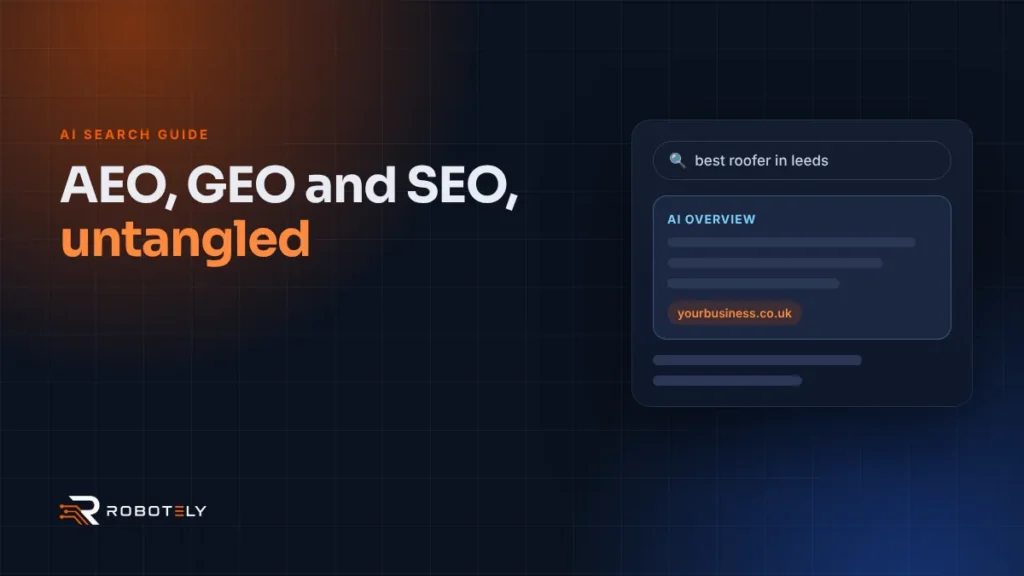
The difference is mainly where your business shows up. SEO targets the normal list of results, AEO targets short direct answers, and GEO targets longer AI-written responses and recommendations.
| SEO | AEO | GEO | |
|---|---|---|---|
| Stands for | Search engine optimisation | Answer engine optimisation | Generative engine optimisation |
| Main goal | Rank pages in search results | Get your content quoted as the answer | Get your brand mentioned or cited by AI tools |
| Where it shows | Google and Bing results, Maps | AI Overviews, featured snippets, voice answers | ChatGPT, Perplexity, Copilot, Google AI Mode |
| What success looks like | Clicks from search | Your page cited in the answer | Your business named in a recommendation |
| Main levers | Technical health, content, links, local signals | Clear, direct answers and structure | Facts, sources, reputation, consistent mentions |
In practice, the lines blur. Google’s AI Mode is both a search engine and a generative tool. Many people use the terms loosely, and you will see agencies use AEO and GEO to mean the same thing. That is fine. What matters is the work, not the label. For a deeper look at the first term, see what is AEO.
Where did the term GEO come from?
GEO comes from academic research. A 2023 paper titled “GEO: Generative Engine Optimization”, later presented at the KDD 2024 conference, coined the term and tested what makes content more visible in AI answers (Aggarwal et al., arXiv).
The researchers reported that the best methods could improve visibility in generative answers by up to around 40%. The strongest techniques were adding quotations, adding statistics and citing sources. Keyword stuffing, an old SEO habit, did not help and in some tests made things worse.
Two caveats are worth knowing. The tests were run on a research benchmark, not on small business websites. And AI tools change quickly. Still, the direction is useful: specific, well-sourced content tends to do better than vague marketing copy.
Do you need three separate strategies?
No. For a small business, splitting your effort three ways would waste time and money. Almost everything that helps one helps the others.
Google states that there are no special optimisations needed to appear in AI Overviews or AI Mode beyond normal SEO best practice (Google Search Central). AI tools still need to crawl and understand your pages, and they still lean on search indexes to find them. Google AI Mode, for example, runs several related searches behind the scenes and combines the results, a method Google calls “query fan-out” (STV News).
So the sensible approach is one joined-up plan. Get the SEO basics right, write clear answers, and build a consistent reputation online. That is how our local SEO service is set up, with AEO and GEO included rather than sold as extras.
Not sure where your website stands?
We can review your site and tell you, in plain English, what is holding it back in both normal search and AI answers. Every quote is tailored to your business.
Which one matters most for a small business?
SEO still matters most, especially local SEO. It is the foundation the other two depend on, and it still brings in most search visits for local businesses.
Think about how people find a plumber, salon or accountant. Many still search Google and look at the map results. Your Google Business Profile, reviews and location pages drive that. AI tools also draw on the same signals when they recommend local businesses, which is why reviews matter more than ever. Our guide to reviews and AI search explains why.
Once your SEO is in good shape, AEO is the next step, because it is mostly a writing job. GEO comes third. It overlaps with your wider reputation: what other sites, directories and customers say about you.
What do all three have in common?
All three reward the same core qualities: a site that can be crawled, content that answers real questions, and evidence that you are trustworthy.
- A fast, mobile-friendly website that search engines and AI crawlers can access.
- Clear service and location pages written in plain English.
- Direct answers near the top of each section.
- Specific facts, such as areas covered, accreditations and typical timescales.
- Consistent business name, address and phone details across the web.
- A steady flow of genuine reviews.
- Structured data that matches what is on the page.
If your website struggles with the first point, fixing that comes first. Our web design team builds sites with this structure from day one.
How should you split your time?
Put most of your effort into the shared foundations, then add the AEO and GEO layers. A simple order of priority works well:
- Fix technical problems that stop pages being crawled or indexed.
- Complete and maintain your Google Business Profile.
- Rewrite key service pages so answers come first.
- Add FAQs and relevant structured data.
- Earn reviews and mentions on trusted local and industry sites.
- Check monthly how AI tools describe your business, and fix gaps.
If you are weighing up paid search as well, our comparison of Google Ads vs SEO may help you decide where budget goes first.
FAQs
Is GEO the same as AEO?
They overlap a lot and many people use them interchangeably. AEO usually refers to direct answers like AI Overviews, while GEO refers to AI chatbots such as ChatGPT and Perplexity.
Has AEO or GEO replaced SEO?
No. AI tools still rely on crawling and search indexes to find content, so SEO remains the foundation. AEO and GEO are extra layers on top.
Which should a small business focus on first?
Start with local SEO, including your Google Business Profile and core service pages. Then make those pages answer questions clearly, which covers most AEO and GEO work.
Does keyword stuffing help with AI answers?
No. Research on generative engine optimisation found keyword stuffing gave little or no benefit. Specific facts, quotations and cited sources performed better.
Do I need a separate agency for GEO?
Not usually. Most GEO work overlaps with good SEO and content writing, so it makes sense to handle it in one plan.