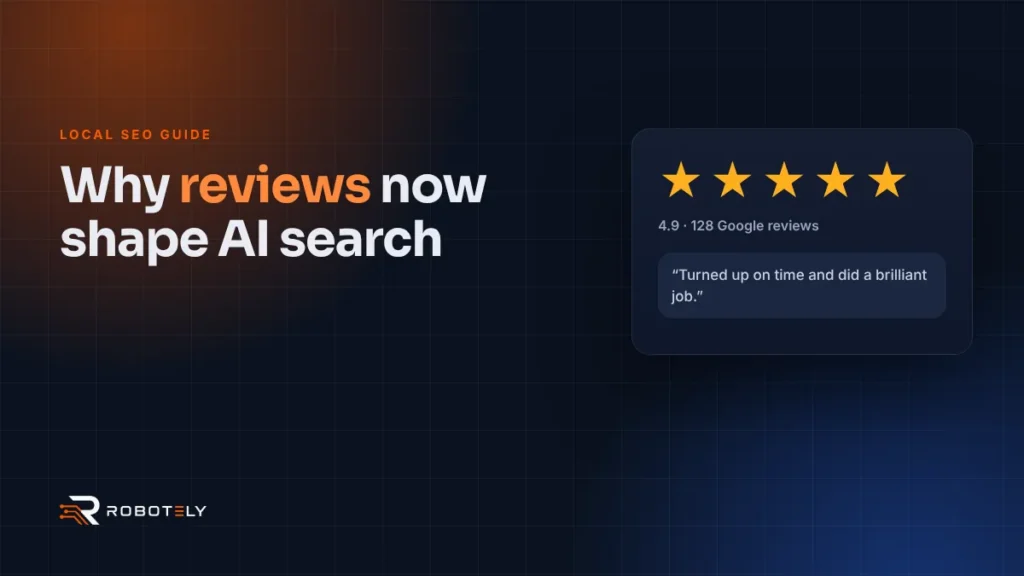
Do online reviews really affect where you rank on Google?
Yes. Google says plainly that more reviews and positive ratings can help your local ranking, so reviews are one of the few ranking signals it confirms in public.
Google’s guidance on local ranking explains that local results are mainly based on three things: relevance, distance and prominence. Relevance is how well your Business Profile matches what someone searched for. Distance is how far you are from the searcher. Prominence is how well known your business is, and Google says this is based partly on links to your website and on how many reviews you have and what they say.
You cannot change distance, and relevance only improves so far. Prominence is where you have most room to grow, and reviews are the part you can work on every week.
If your listing still needs setting up properly, start with our guide to getting your business on Google Maps.
How do AI search tools use your reviews?
AI tools read reviews as evidence. When someone asks for “a reliable plumber in Leeds” or “the best nail salon near me”, the tool looks for businesses that real people talk about positively and specifically.
Google’s AI Overviews and AI Mode draw on the same data as normal search. ChatGPT, Copilot and Perplexity search the web too, so they can find review sites and directories as well as your own pages.
What matters most is the detail inside the review. A review that says “Sam fitted our new boiler in Harrogate in one day and left the place spotless” tells an AI system what you do, where you work and why people like you. A review that just says “great” tells it very little. You can learn more about how AI tools choose who to mention in our guide on how to get recommended by ChatGPT.
Which review platforms matter most for a UK local business?
Google reviews matter most for local businesses, because they feed Google Maps directly. After that, pick one or two platforms your customers actually check.
| Platform | Best for | Why it helps visibility |
|---|---|---|
| Google Business Profile | Almost every local business | Feeds local ranking and Maps |
| Trustpilot | Online shops, services that sell nationally | Widely recognised by shoppers |
| Facebook recommendations | Salons, cafés, community-focused businesses | Social proof where locals spend time |
| Trade and sector directories | Trades, clinics, professional services | Independent, trusted mentions |
| Reviews on your own website | Everyone | Detailed feedback on service pages |
Want more customers finding you on Google and in AI answers?
We help UK local businesses build their Google Business Profile, reviews and website so they show up when customers search.
What are the UK rules on fake and incentivised reviews?
Fake reviews are banned under the Digital Markets, Competition and Consumers Act 2024. The rules came into force on 6 April 2025, and the Competition and Markets Authority (CMA) has published guidance for businesses.
The CMA’s short guide for businesses lists the banned practices. These include fake reviews, reviews that hide the fact they were paid for or rewarded, and ratings or summaries based on fake reviews. Writing or commissioning fake reviews is also banned. Under the new regime the CMA can fine businesses directly, with penalties of up to 10% of worldwide turnover, as law firm BCLP explains.
Google’s own review policies go further. You must not offer discounts, freebies or payments in exchange for reviews. You must not ask only happy customers for reviews, or discourage negative ones. Google can remove reviews that break these rules.
In practice, that means:
- Never write reviews for your own business or ask staff, friends or family to do so.
- Never buy reviews or use a service that promises them.
- Do not offer a discount or prize in return for a review.
- Ask all customers, not just the ones you think will be happy.
- Never pressure customers to leave a review while they are with you.
How can you get more genuine reviews without breaking the rules?
Make it easy and ask at the right moment. Most happy customers are willing to leave a review, but few will go looking for the link themselves.
- Get your short review link from your Google Business Profile.
- Ask in person when the job is done, then follow up by text or email with the link.
- Add the link to invoices, receipts and email signatures.
- Ask customers to mention the service and the area, without telling them what to say.
- Set a simple routine, such as asking every customer within 24 hours of finishing.
- Check new reviews weekly so none go unanswered.
Aim for a steady flow. A sudden burst of reviews can look suspicious to customers and platforms.
Should you reply to reviews, including the bad ones?
Yes. Google says positive reviews and helpful replies can help your business stand out, and replies show both people and AI tools that you care about service.
Keep replies short, polite and specific. Thank people by name and avoid copying the same reply every time. For a negative review, stay calm, apologise, explain briefly and offer to sort it out offline. Never share a customer’s personal details in a reply.
How do reviews fit into your wider SEO and AI visibility?
Reviews work best alongside a strong website and a complete Business Profile. They cannot rank a business with thin pages.
Make sure your website has clear service pages, your name, address and phone number are the same everywhere, and your profile categories are accurate. You can also add review snippets to your site and mark up your business details with structured data, which we cover in our guide to schema markup for small businesses. If you are wondering how this all fits together, our explainer on AEO vs GEO vs SEO sets out the differences.
FAQs
Do more Google reviews help my ranking?
Yes. Google says more reviews and positive ratings can help your local ranking, because reviews feed into prominence.
Is it legal to offer a discount for a review in the UK?
Offering a reward and hiding it is banned under UK consumer law, and Google’s policies ban incentives for reviews altogether. The safest approach is never to reward reviews.
When did the UK fake review ban start?
The ban under the Digital Markets, Competition and Consumers Act 2024 came into force on 6 April 2025. The CMA has published guidance explaining what businesses must do.
Do AI tools like ChatGPT read Google reviews?
AI tools search the web and can pick up reviews and ratings about your business from many sites. Detailed reviews give them clearer evidence.
Should I delete or hide bad reviews?
You cannot simply delete genuine Google reviews, and you must not suppress negative ones. Reply calmly and report only reviews that break the platform’s rules.